
How the Grill Works
The S1 grill heats up using a wood pellet fire, the electric element, or a combination of both, depending on the selected cooking mode.
In AUTO mode either the wood pellet fire or wood pellet fire plus electric element work together. Refer to this page for information about all the cooking modes.
AUTO Mode – Low Temp
- At target temperatures of 135℃ (275℉), and below, only the wood pellet fire is used.
- For example, if set to 90℃ (194℉), wood pellets are fed into the fire in batches once every 20 to 100 seconds. The rest period between batches adjusts automatically based on how much heat is needed to reach and maintain the target temperature.
- When starting from cold, a larger fire is needed to heat up quickly; as the target temperature is reached, a smaller fire (fewer pellets) maintains it.
AUTO Mode – High Temp
- At target temperatures above 135℃ (275℉), the electric heating element also contributes heat in MEDIUM and HIGH smoke settings. The LOW smoke setting will only engage the heating element at very high (<260℃ (500℉) targets.
- The element turns on and off in a set cycle to provide a base level of heat, while the wood pellet feed fluctuates using PID control logic (explained below).
- For example, at 200℃ (392℉) with HIGH smoke setting, the element will run 24 seconds on, 36 seconds off, delivering around 720 watts of base heat. Wood pellets provide the remaining heat needed to reach and hold the target temperature.
PID Control Logic
- The controller uses PID logic to find the best on/off pellet feed ratio for stable temperature control. This ratio is adjusted every 1 to 2 minutes.
- If the temperature is rapidly approaching the target temperature or is already above it, the off period will be lengthened.
- If the temperature is dropping, or below the target temperature, the off period will be shortened.
- This logic has been refined through thousands of hours of testing to:
- Reach the set temperature quickly, without excessive overshoot.
- Hold the temperature as steadily as possible.
- Respond to temperature changes, in particular when the lid is opened.
- If the temperature drops, the controller shortens the “off” time so more pellets are delivered. If it exceeds the target, it increases the “off” time to reduce heat.
- It is important to note that a wood fire is not as precise a heat source as electricity or gas and so temperature fluctuations will still occur. Wood varieties also provide different heat output levels, which impacts how quickly the grill can heat up.
Temperature Swings
- The adjustments in the wood pellet delivery batches naturally cause small swings above and below the target temperature.
- Each time the lid is opened, heat escapes, and the controller ramps up pellet feed to recover. It usually takes 5 – 10 minutes for the temperature to stabilise again.
- Swings of about ±15% during heat-up, and ±10% when stable, are normal.
- The grill’s temperature reading is based on hot air blowing past the sensor and exiting through the left wall vent. This air measurement shows more variation than the actual heat at the grill rack, where food receives a more even blend of convective (airflow) and radiant (from metal surfaces) heat.
Temperature Spikes
- At low target temperature operation (70 to 100℃ / 158 to 212℉), the grill operates with a very small fire, using only about 180grams (1 cup) of wood pellets per hour.
- With such a small fire, it can sometimes go out. Once the temperature drops the controller turns the pellet ignitor back on to relight the fire – resulting in a temperature spike back up as the accumulated pellets burn and release a larger batch of heat.
- If this happens repeatedly (more than twice an hour), consider setting a higher temperature setting that will delivery wood pellets more frequently.
- Ensure short, clean, fresh wood pellets are used. If many of the pellet are longer than (>25mm), it result in a very uneven delivery of pellets each cycle – and much greater likelihood of the fire going out.
Fire Going Out & Relighting
If the fire is regularly going out, indicated by the temperature dropped down by 10-20℃ then spiking back up a few things can be done to remedy this.
- If operating at a low temperature, try setting a higher target which will have a higher minimum pellet delivery rate (kg/hour). See the section Grill Running Too Hot (below) for methods to help keep the temperature down if the grill runs too hot.
- Long wood pellets can cause the fire going out when operating at low temperatures with a small fire, as instead of dropping 5-10 pellets each cycle, only a few may drop. They can also just interfere with the consistent delivery of pellets. If lots of the pellets are longer than 20mm, mix in some shorter pellets from another brand or variety.
- Check to ensure the air holes in the fire grate are clear and there is not an excessive accumulation of ash in the fire grate.
Slow Temperature Increase
- When changing the target temperature by a small amount (e.g. 80 → 100℃ / 176 → 212℉), the grill may take 10–15 minutes to reach the new setting. This is because the controller makes gradual pellet feed changes to avoid overshooting.
- For large changes (e.g. 80 → 200℃), the grill will increase pellet feed more aggressively and can reach the new target in a similar 10 – 15 minute timeframe.
Slow Temperature Decrease
- When lowering the target from a high to a low temperature, the drop can be slow because the fire is still producing heat and the grill’s insulation retains it well.
- To speed this process up:
- Shut down the grill — this stops pellet feeding and increases fan speed to allow the fire to burn out, and cool the grill down. Within 5-10minutes the grill will have dropped temperature significantly.
- Once near the new target temperature, fire up the grill again. If the grill is still shutting down (fan blowing), just power cycle (turn the physical power switch on the hopper off/on), and fire up again.
Grill Running Too Hot
The lowest target temperature the grill can be set to depends on the ambient temperature (as measured by the grill inside the hopper). This is because the smallest fire will still achieve around a 60℃ temperature rise, so as the weather gets hotter the minimum temperature possible also rises. The following are the minimum temperatures the grill will allow in AUTO and Wood Fired Rotisserie modes.
- <15℃ ambient = 70℃ / 158℉ lowest temperature
- <25℃ ambient = 80℃ / 176℉ lowest temperature
- <35℃ ambient = 90℃ / 194℉ lowest temperature
- >35℃ ambient = 100℃ / 212℉ lowest temperature
Pellet Only Smoker mode does not have the above minimum restrictions (can set to 70℃ / 158℉), providing flexibility, but requires the knowledge that the grill may not be able to settle as low as the target setting. Following the tips below can help increase heat loss for lower temperature operation.
Increase heat loss by:
- In the summer (or all year round in hot climates) the inner rear insulating panel can be removed which allows more heat loss, and lower temperature operation.
- The Lid Rotisserie Slot Cover can be removed to allow more heat loss.
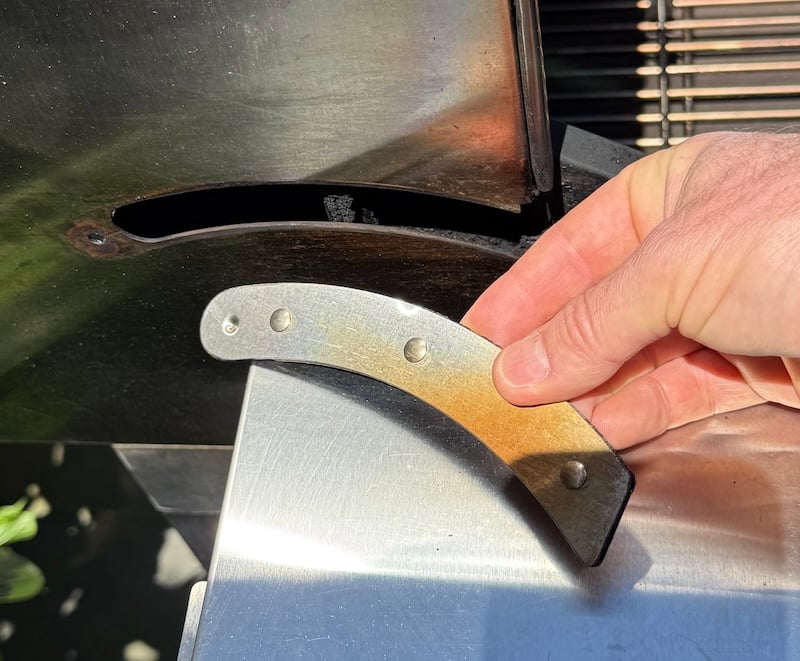
- The lid can be slightly wedged open (4-5mm) to further increase heat loss.
- Keep the grill in the shade – as direct sunlight can add 10 to 20oC to the grill temperature.
- Provide additional airflow across the grill body and lid using a fan.
- Use a mixture of oak and hardwood pellets – as oak provides less heat per kg than hardwood.
Grill Running Too Cool
- If the grill is struggling to reach the target temperature, the most likely cause is poor-quality or damp pellets, which burn inefficiently.
- Try swapping out the pellets with fresh, dry ones first. If still having issues, please contact us.
Temperature Sensor Failure
If the grill temperature sensor has failed Error 21 will result and the grill will shut down.
Click here for more information.